Summary
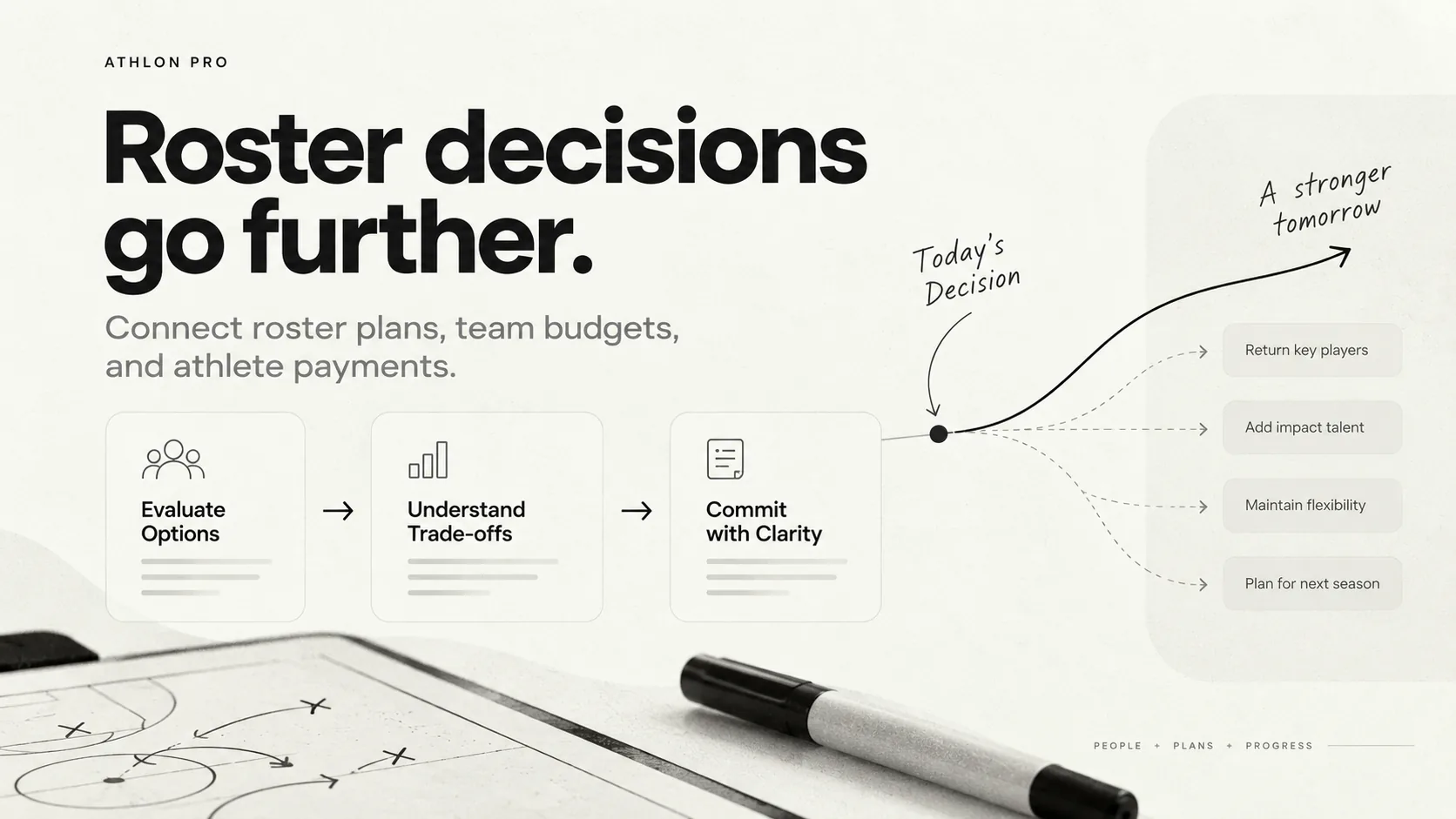
- Roster plans, team budgets, and signed commitments are three views of the same decision, not three separate plans.
- Recent changes in college athletics have moved athlete-related financial decisions further into a department’s day-to-day responsibilities.
- An offer that fits this season can still limit what the program can do next season, so future commitments belong in the conversation early.
Can we make this offer?
Picture that question coming up in a basketball staff meeting. The coaches have identified a player who addresses a real need. The general manager is working through the terms. There is interest on both sides, and the staff wants to move.
But before anyone answers, another set of questions needs attention.
How much of the team’s allocation is already committed? Does the number everyone is looking at include the latest agreement? Have we protected what we need for returning players? What would this offer leave for the remaining roster spots, and for next season?
A recruiting board cannot answer all of that. Neither can a budget spreadsheet that has not caught up with the latest commitments. A payment report shows what has gone out, but not necessarily everything the program has agreed to pay.
The roster, the budget, and the commitments are not three separate plans. They are three views of the same set of decisions.
Planning the roster like a balance sheet starts with treating them that way.
The roster meeting and the budget meeting are moving closer together
The approval of the House settlement in June 2025 opened a framework for participating Division I schools to provide direct financial benefits to athletes. That brought another set of athlete-related financial decisions directly into the department’s responsibilities.
Changes in how programs organize their staff also show roster strategy and resource planning moving closer together.
When Stanford announced its football general manager position in November 2024, the responsibilities combined recruiting and roster management with work alongside athletics and university leadership on fundraising, sponsorships, and other program priorities.
Wake Forest made the connection more explicit in its August 2025 announcement of a general manager for men’s and women’s basketball. The role included roster construction, transfer evaluation, resource allocation, planning, and working with athletes’ representatives.
These announcements do not tell us how every department operates. But they illustrate a meaningful change: evaluating the roster and understanding the resources behind it are increasingly being placed within the same responsibilities.
The next step should be making sure the information works that way, too.
A general manager should not have to choose between an up-to-date recruiting conversation and an accurate financial picture. The people responsible for both should be able to work from the same recorded commitments.
A financial discipline, not a price tag on a person
“Balance sheet” is a way of thinking here, not a proposal to put athletes on a university’s books as assets. Nor is a roster-planning tool a substitute for the institution’s formal accounting.
The useful idea is to look at the whole position before making the next commitment: the resources available, the obligations already created, and the flexibility left to address future needs.
That perspective should support the work of coaches, not replace it.
Your staff may see a player whose ability to defend multiple positions changes what you can do. You may value an experienced setter who can lead a young volleyball team, or a pitcher who gives your rotation needed depth. Those are sporting judgments.
The financial question is what it takes to pursue that judgment without losing sight of the rest of the program.
The aim is not the cheapest roster. It is a roster your staff believes in, backed by a plan the department can support.
“Available” has to mean the same thing to everyone
Consider a simplified basketball example.
A program has a $2 million internally approved allocation for athlete commitments for one season. This is an example of a team budget, not its entire operating budget or a regulatory spending limit.
The program has signed agreements totaling $1.5 million. Of that amount, $600,000 has been paid, leaving $900,000 still owed.
The uncommitted portion of the allocation is $500,000.
Not $1.4 million.
The difference matters. Looking only at payments would show $600,000 going out. Looking at commitments shows that $1.5 million of the allocation is already spoken for.
Those are different questions: how much budget remains, how much cash is available, and how much is still owed. Athlon’s planning approach treats them separately; making a payment reduces an unpaid obligation, rather than restoring the roster budget already committed to it.
Now suppose the staff wants to propose $300,000 to another player. That would leave $200,000 uncommitted.
On its own, the offer fits.
But suppose the staff also intends to reserve that remaining $200,000 for two returning players. Those renewals are not signed obligations yet, but they are part of the roster plan.
The new offer would therefore leave no additional room within that plan for another need.
That does not make it a bad offer. It changes the conversation from “We have enough” to “We have enough if these remain our priorities.”
A useful financial picture should make both statements visible: what is formally committed and what the staff is planning to protect. It should not combine them into an unexplained “remaining” number.
Next season is already part of this season’s decision
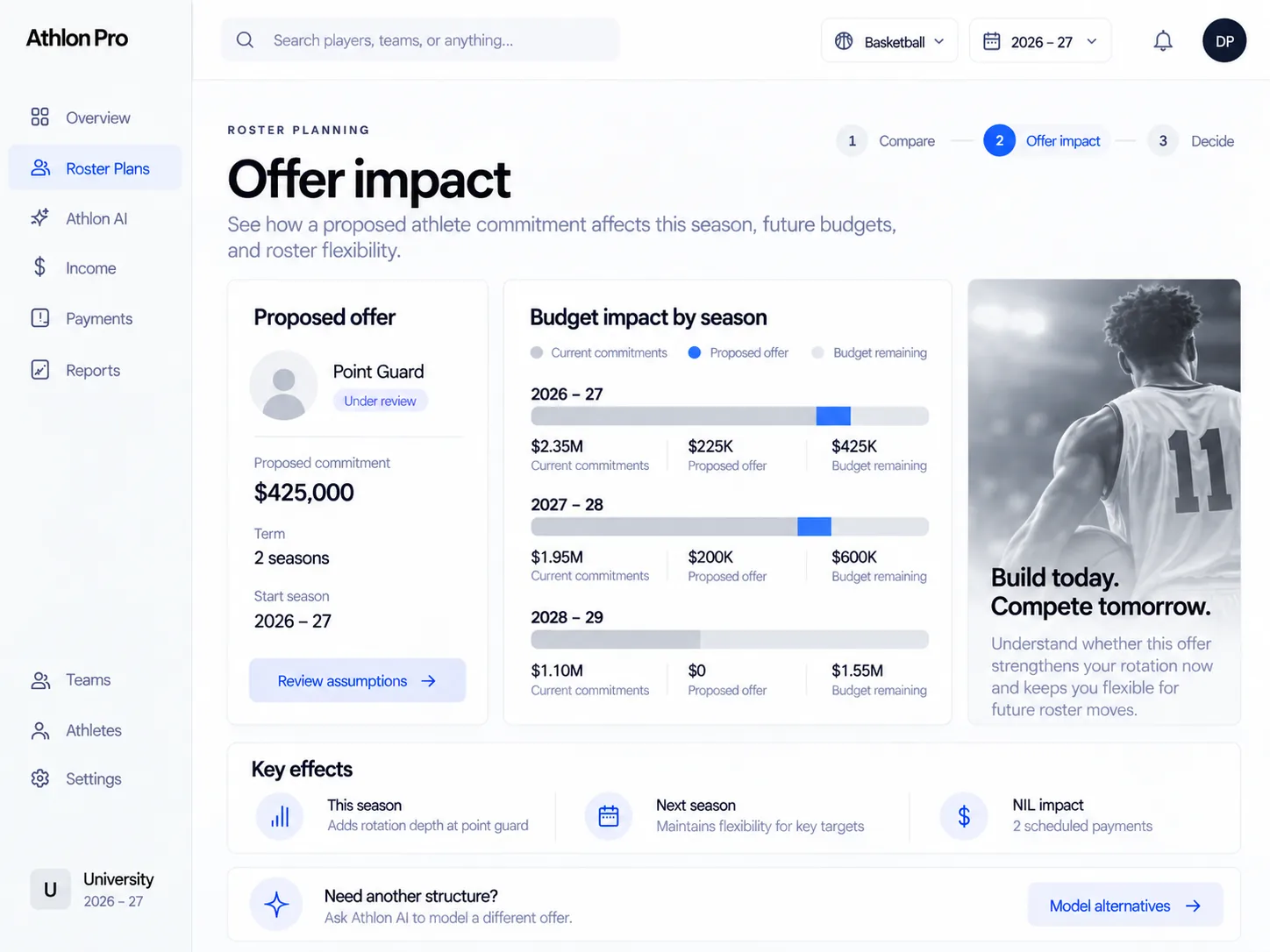
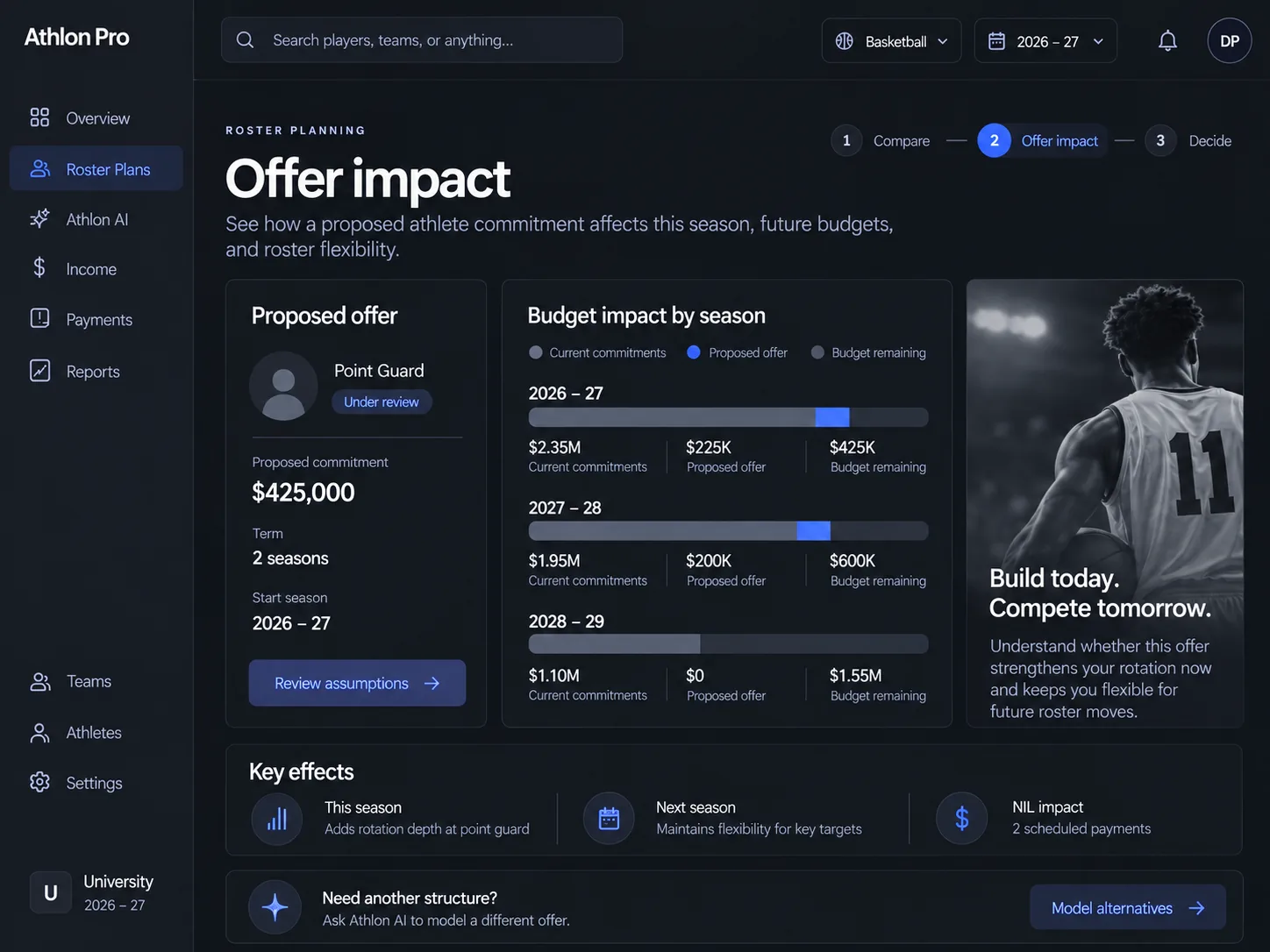
An offer can be manageable this year and restrictive next year.
Suppose a proposed agreement includes an amount for the current season and a larger amount for the following one. Comparing only the first-season cost understates the decision the program is considering.
The staff should see the future commitment beside the future roster.
Who do we expect back? Which positions will need attention? What have we already agreed to? How much of next season’s allocation is confirmed, and how much is still an assumption?
A projection built on a larger future budget should say so. So should a plan that assumes certain renewals, departures, or additional funding.
That is not an argument against making multiseason commitments. Continuity may be exactly what a program wants. It is an argument for understanding the commitment across the period it covers.
There is a difference between choosing to use future flexibility and discovering later that it is gone.
For an athletics director, this view should also extend beyond one team. A proposed increase for one program deserves to be considered alongside existing commitments, other teams’ needs, and the department’s broader priorities.
A decision can be sensible for a single roster and still require a larger departmental conversation.
One financial picture does not mean one interchangeable pool of money
Connecting information should not erase the distinctions between different kinds of support.
The House settlement framework distinguishes direct financial benefits from schools and third-party name, image, and likeness agreements. They should not be treated as identical simply because both may matter to an athlete’s overall financial situation.
For planning purposes, the department should be able to identify who is responsible for each commitment, what period it covers, and what is confirmed.
An independent sponsorship opportunity should not quietly become part of a spending pool the department assumes it controls. Expected support should not appear indistinguishable from money received. A proposed allocation should not look like an approved one.
The same principle applies to competing roster scenarios.
The staff may be comparing two players for one role. Those are alternatives, not necessarily two offers it intends to make together. The plan should make that relationship clear rather than counting both as firm commitments, or ignoring the exposure if both offers are actually outstanding.
A connected system should make important differences easier to see, not hide them behind one large total.
Fix the handoff, not just the spreadsheet
The problem is not that a coach uses a spreadsheet. A spreadsheet can be a useful working tool.
The problem comes when a change in one place does not reach the people whose next decision depends on it.
Imagine the proposed amount changes during a discussion with a player’s representative. The recruiting sheet gets updated, but the budget forecast does not. An agreement is then approved using the new amount, while the person preparing the payment schedule receives an older version.
No individual file needs to look obviously wrong for the overall picture to become unreliable.
The better approach is to connect the stages of the decision.
An internal scenario should remain identifiable as an internal scenario. An offer under discussion should have a clear status. An approved agreement should connect to its actual terms, payment schedule, and remaining obligation. Changes should show who made them and when.
Staff should be able to explore alternatives without accidentally changing a signed commitment. Running a comparison should not authorize an offer or send a payment.
This is partly a technology problem, but it is also a responsibility problem. Someone needs to own the accuracy of the commitment record. Someone needs to approve changes. The people making offers need to know which information is current.
For a coach, that could mean getting an answer without chasing three people. For a general manager, it could mean comparing options without rebuilding the budget. For finance, it could mean receiving an approved commitment rather than trying to reconstruct it from a message thread.
The practical goal is straightforward: the next person should not have to rediscover what the last person already decided.
Athletes and families deserve clarity on their side of the agreement
A department may think about a commitment as one part of a roster plan. An athlete may be weighing that same commitment alongside playing opportunity, development, education, and where to spend the next part of their life.
Both perspectives matter.
For an athlete, parent, agent, or manager, the important questions should have clear answers. What is being offered? Who is making the commitment? What period does it cover? What are the payment dates and relevant conditions? Which details remain under discussion?
After an agreement is in place, the questions become equally practical: what has been paid, what remains, and who handles a discrepancy?
The people asking those questions should not have to understand the department’s internal workflow to get a consistent answer.
That does not require giving every athlete or representative access to a team’s full budget or another player’s information. It requires the program to maintain an accurate record behind the information it shares.
Financial discipline should also mean resisting the temptation to present an uncertain amount as a settled commitment simply because it helps a recruiting conversation.
A program can negotiate firmly and still communicate clearly. It can protect its internal planning information while being precise about the agreement in front of the athlete.
Managing commitments well should help a department follow through, not give it another way to explain away a promise.
Better information should leave more room for judgment
Connecting the roster and the finances will not make every decision obvious.
Your staff may still disagree about whether to prioritize a proven starter or two developmental players. You may decide to spend more on a particular need than a simple comparison would suggest. You may deliberately keep money uncommitted because flexibility matters to the plan.
Those are decisions to make with clear information, not decisions for software to erase.
The same standard should apply to AI. A useful comparison should explain the inputs, assumptions, and trade-offs. It should not turn a financial model into a claim that one player is objectively the right choice.
That is the approach we’re building around at Athlon Pro: connecting allocations, roster alternatives, offer consequences, commitments, and athlete payments, with AI helping staff explore the options while staff retain the decisions.
The purpose is not to move the coaching staff into the finance office. It is to make sure neither group is making an important decision without information the other already has.
“Those are decisions to make with clear information, not decisions for software to erase.”
Build the team. Understand the commitment.
A depth chart shows how you might compete. A budget shows the resources you have allocated. A commitment record shows what you have agreed to support.
The value comes from reading them together.
Before the next offer, the staff should be able to see what is available and what other priorities depend on it. Before approval, the department should understand the effect across seasons. After the agreement, the payment record should connect back to what was promised.
That is what planning the roster like a balance sheet should mean.
Not reducing athletes to numbers. Not letting finance pick the starting lineup. Not replacing a coach’s judgment with a model.
It means building the roster with a full understanding of the commitments behind it, and giving the people making those commitments a plan they can stand behind.
Frequently asked questions
A commitment records what a program has agreed to provide, while a payment records what has already been fulfilled. A program can have substantial unpaid obligations even when comparatively little cash has gone out, so both views matter when evaluating what remains available.
A multiseason agreement can use part of a future allocation before the rest of that roster is settled. Coaches, general managers, athletics leadership, and finance teams should see that future obligation alongside expected returners, position needs, and clearly stated planning assumptions.
No. They may both affect an athlete’s overall financial picture, but they can have different sources, responsibilities, terms, and levels of certainty. A connected planning view should preserve those distinctions instead of presenting every amount as one interchangeable pool.
They should be able to. An internal scenario or proposed offer should remain clearly separate from an approved agreement. Comparing alternatives should not change a signed commitment, authorize an offer, or trigger a payment.
They should receive clear information about what is being offered, who is making the commitment, the period covered, payment dates, relevant conditions, and which details remain under discussion. That clarity does not require access to another athlete’s information or the department’s full internal budget.
See what Athlon Pro can do
Explore roster alternatives and understand every commitment before you make it.
Request a Demo