Summary
- A roster decision is also a financial commitment, so both belong in the same view.
- The goal is not to spend the least, but to put resources where the staff believes they matter most.
- Every offer should be weighed against this season and the next before it is agreed to.
Different perspectives, same decision
You want to keep your core together, address the holes in your roster, and give your team a chance to compete. You also have a budget that cannot cover every player you would like to bring in or every offer you would like to make.
For a coach or general manager, that means making choices. Do you prioritize a proven starter or add depth? How much can you commit to a new addition while protecting what you need for returning players? Does a deal that works this season leave enough room to build next year’s team?
For an athletics director, those decisions sit inside a larger responsibility: supporting multiple programs, setting priorities, and understanding the commitments being made across the department.
And for the athlete considering an offer, the questions are just as important. What is the actual commitment? When are payments scheduled? What should they and the people advising them be able to count on?
These are different perspectives on the same decision.
We’re building Athlon Pro to connect the roster a program wants to build with the commitments it can support, and the payments that follow. Our focus is college athletics departments and the coaches, general managers, roster staff, and finance teams responsible for those decisions.
Build a stronger roster, not just a more expensive one
The goal is not to spend the least. It is to put your resources where your staff believes they will make the biggest difference.
That starts with knowing what you already have, what you need, and what you can afford to commit.
Consider a football program with $5 million allocated and $4 million already covered by signed commitments. That leaves $1 million to work with.
The staff is comparing two approaches. One puts $650,000 toward an experienced starter, leaving $350,000 for other needs this season. Another puts $450,000 toward depth and flexibility, leaving $550,000.
Both fit the current budget. They do not build the same roster or leave the same options open. Those are the kinds of comparisons illustrated in our roster-planning example.
The useful conversation is not simply, “Which one is cheaper?”
It is whether the experienced starter addresses the most important need. Whether the second approach gives you enough quality across the rotation. Whether you still have room to retain someone your staff wants back. Whether spending more in one position group leaves another too thin.
Your coaches bring the evaluations. Your general manager brings the roster plan. Your department sets the financial parameters.
We want Athlon Pro to help bring those inputs together so the staff can see what each approach strengthens, what it leaves unresolved, and what it costs to pursue.
An offer has to work this season and next
A deal can fit today and still create a problem for the roster you need to build tomorrow.
Return to that example. The depth-and-flexibility approach leaves more available this season, but it also includes a proposed $400,000 commitment next season. That future amount belongs in the conversation before the staff chooses a direction, not after.
This does not make the approach wrong. It makes it a different decision.
A coach may believe the continuity is worth it. A general manager may want to preserve more flexibility. An athletics director may need to consider how that commitment fits with the program’s future allocation.
The point is to make the trade-off visible.
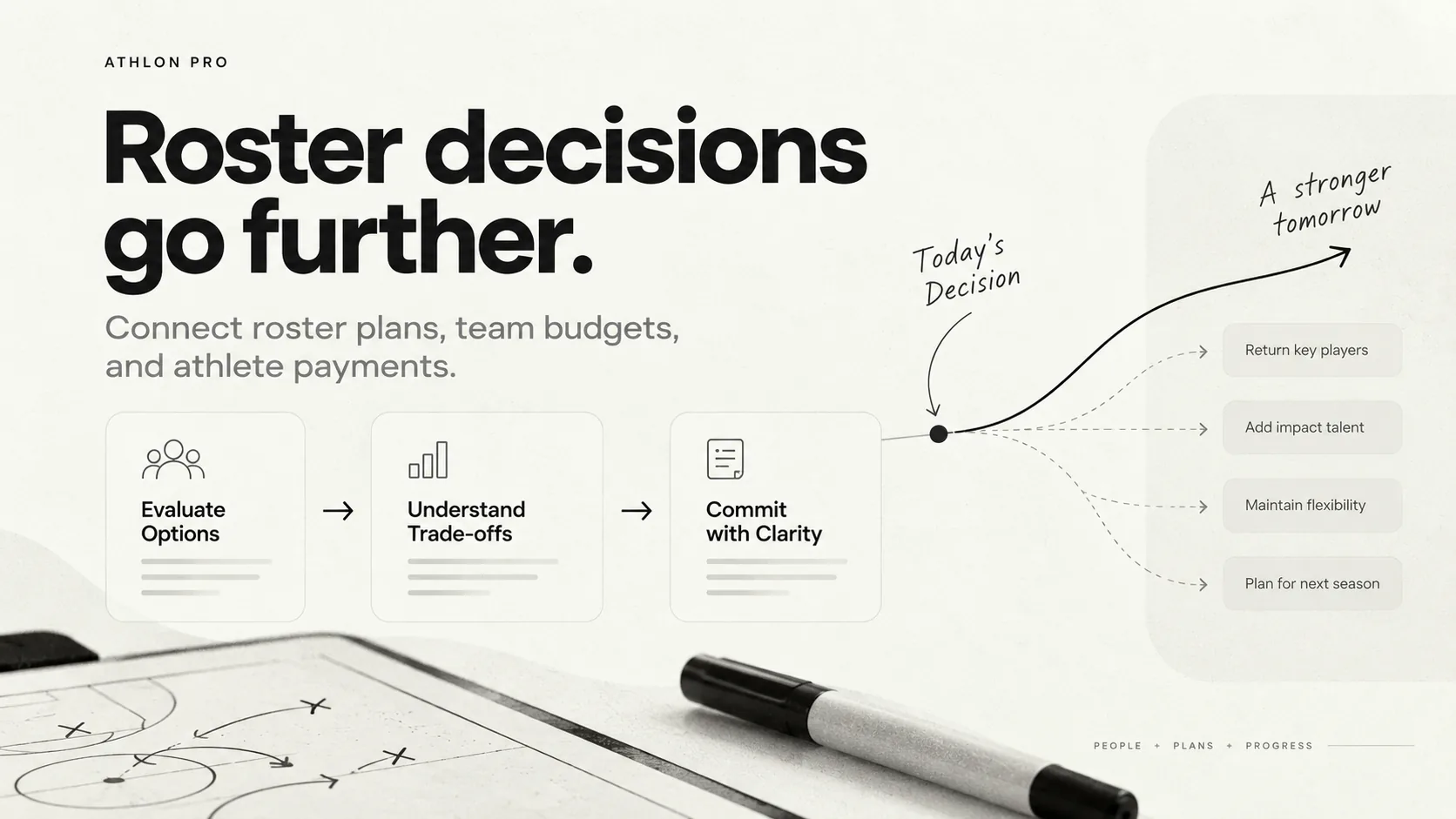
We’re building Athlon Pro around that question: What does this offer commit us to, and what options does it leave us next? The intended workflow connects roster alternatives with their consequences across seasons, before an approved commitment becomes part of the program’s plan.
That also means keeping a clear distinction between what is being considered and what has already been agreed to.
An unsigned proposal is not a signed commitment. Money committed but not yet paid is not automatically available for another offer. And a projection for next season is only as useful as the assumptions behind it.
Those distinctions should be easy to see when your staff is making a decision.
AI should help your staff think, not decide for them
A coach should not have to turn every roster question into a financial model before getting a useful answer.
The question should be able to sound like a staff meeting:
“We need to strengthen the offensive line. Compare adding an experienced starter with adding depth. Keep our signed commitments intact, and show us what each approach leaves for this season and next.”
That is the role we see for AI in Athlon Pro.
It should help explore alternatives around your staff’s evaluations, positional needs, priorities, and financial limits. It should explain why one option leaves more flexibility, where another concentrates your resources, and which assumptions could change the comparison. The staff retains control of the decision.
We are not treating player evaluation as a problem that disappears because a model can produce an answer.
Your staff still has to judge fit, development, readiness, and what a player brings to the team. An option that looks efficient financially may not solve the need your coaches consider most important.
AI should make the trade-offs easier to understand. It should not turn a financial comparison into a claim that one player or roster is objectively the best.
The decision still belongs to the people responsible for the program.
Know what’s owed. See what’s paid.
Agreeing to a commitment is not the end of the work.
The program then needs to follow it through: record the commitment accurately, understand the payment schedule, track what has been paid, and know what remains due.
That is why athlete payments are part of the same product story, not an unrelated task after roster planning is finished.
We’re building toward a connected workflow in which approved commitments carry through to payment scheduling and tracking, with each athlete’s payment history, upcoming payments, and remaining balance clearly organized.
For the people managing the program, three questions need distinct answers: How much roster budget remains? What cash is available? What do we still owe?
Making a payment reduces the unpaid obligation. It does not erase the original commitment or make that same roster budget available to spend again.
The person managing payment records should not have to reconstruct the roster decision. The person making the next offer should not have to guess what has already been committed.
They should be working from information that connects.
The athlete’s side of the conversation matters, too
We’re building Athlon Pro first for the people running college athletics programs. But the quality of those programs’ financial decisions matters to the athletes on the other side of the commitment.
For an athlete, an offer is part of a bigger decision about where to compete, develop, study, and spend an important part of their life.
For a parent, the conversation may be about understanding what has actually been offered and helping their child weigh it alongside the opportunity at the school.
For an agent or manager, the work includes understanding the terms, representing the athlete’s interests, and keeping track of the commitments made.
A headline dollar amount does not answer every question.
What period does the offer cover? What is the payment schedule? Which details are still under discussion? Once an agreement is in place, what has been paid and what remains?
Our view is that a program should be able to answer questions about its own commitments clearly and consistently.
That does not mean an athlete, parent, or representative needs access to a department’s internal roster budget or another player’s information. It means the department should have an accurate record behind the answers it gives.
It also means being clear about what we mean by making every dollar count.
We do not mean paying athletes as little as possible. We mean helping a program understand its choices, make commitments it can support, and follow through on what it agrees to.
A tool built for the department should still respect the people whose lives are affected by those decisions.
Give the staff the same starting point
Coaches, general managers, athletics directors, and finance staff do not need to approach every decision the same way. Their different responsibilities are part of why the conversation matters.
The coach needs to know whether the roster can compete.
The general manager needs to balance retention, recruiting, depth, and future needs.
The athletics director needs to understand how team decisions fit within the department’s priorities.
The finance team needs an accurate picture of commitments and payment obligations.
They should be able to disagree about an approach without first having to figure out whose numbers are current.
When one version of a proposed offer is in a message, another is in a spreadsheet, and the payment record is somewhere else, even a straightforward question can turn into a search for the right information.
The shared view we’re working toward is meant to give staff a better starting point: the same recorded commitments, the same proposed alternatives, and clearly stated assumptions. From there, they can discuss the judgment calls that actually require their attention.
This is not only a football or basketball problem.
A baseball staff may be weighing pitching depth. A volleyball staff may be planning around returning players and positional needs. A department may be considering allocations across several teams at once.
The roster questions differ. The need to understand commitments does not.
Athlon Pro is being built to support all college sports, rather than treating football and basketball examples as the limits of the platform.
Build a roster you believe in, and a plan you can stand behind
Software cannot remove the difficult choices from running a program. There will still be players you want but cannot fit, priorities your staff sees differently, and uncertainty about what next season will bring.
Our aim is to make the financial side of those decisions easier to understand and follow through.
Before an offer, understand the options.
Before a commitment, understand its effect on this season and next.
After an agreement, keep a clear record of what is owed, what has been paid, and what comes next.
For coaches and general managers, that means a clearer basis for building the team. For athletics directors and finance staff, it means a clearer picture of the obligations they are responsible for. For athletes, parents, and representatives, it means programs that are better equipped to explain and track their commitments.
That is why we’re building Athlon Pro.
Build stronger rosters. Make every dollar count.
Frequently asked questions
Athlon Pro is being built to help authorized college athletics staff connect roster plans, financial allocations, athlete commitments, and payment records so they can understand the effects of a decision before and after an agreement is made.
The product is intended for college athletics coaches, general managers and roster staff, athletic directors and department leaders, and finance or operations teams involved in roster and athlete-payment decisions.
No. Coaches and staff keep responsibility for player evaluation, roster priorities, and final decisions. Athlon Pro is intended to help them compare scenarios and understand the financial consequences of the choices they are considering.
That is part of the planning approach described in the article. Staff should be able to compare alternatives, review current and future effects, and explore assumptions before a proposal becomes a signed commitment or a payment instruction.
No. A connected record does not mean unrestricted access. Coaches, finance staff, athletes, parents, and representatives can have different information needs, and any product access should reflect authorization, privacy, and each person's role.
See what Athlon Pro can do
Explore roster alternatives and understand every commitment before you make it.
Request a Demo