Summary
- There are now 500,000+ college athletes in the U.S. competing across ~1,100 schools, and that number keeps climbing.
- The NIL market is projected around $1.67B in 2024–25, with credible estimates suggesting $2.3B+ in NIL value and multi-billion-dollar revenue-sharing caps kicking in on top. With expected growth in 2026 to reach above $6B+.
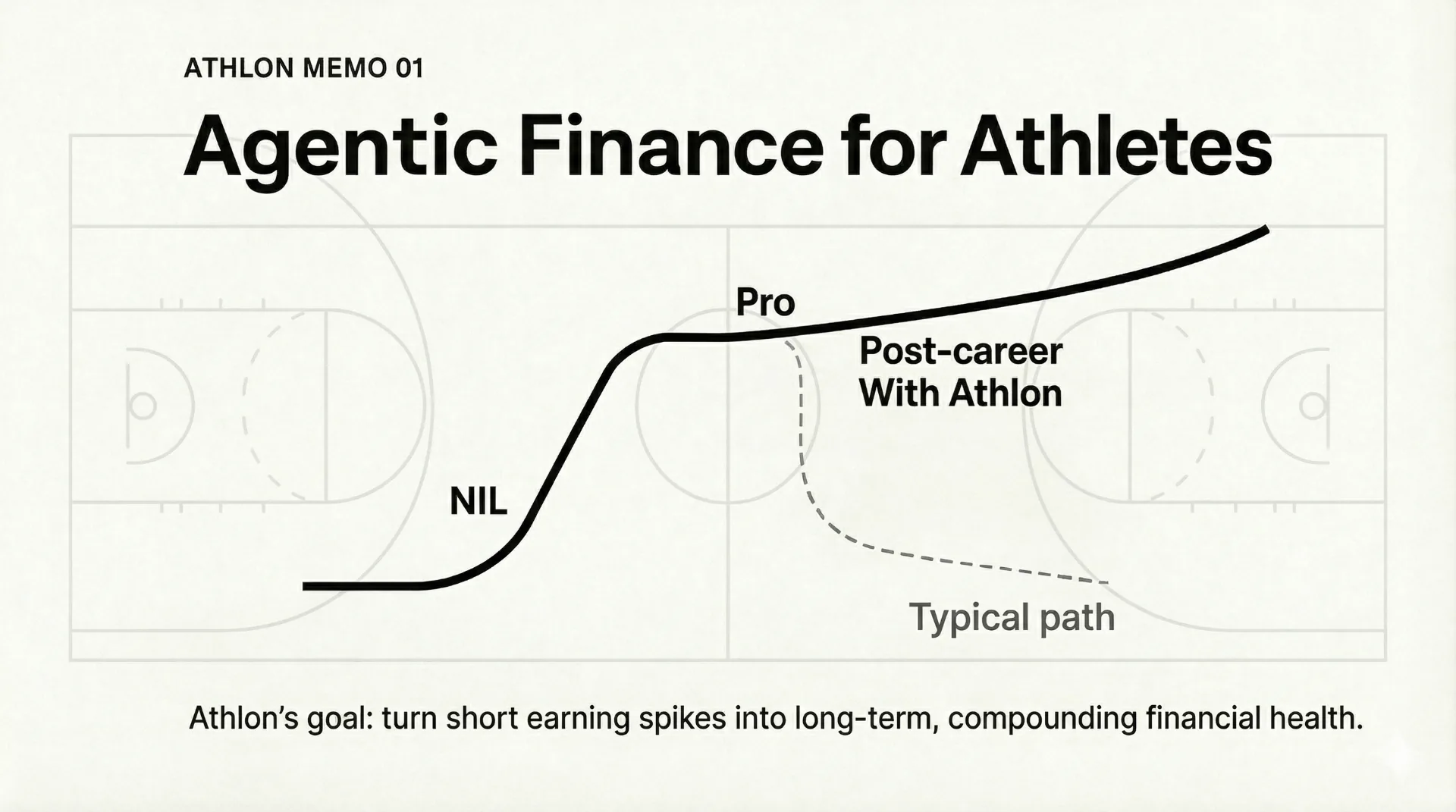
- The "broke athlete" story remains real: research still finds double-digit bankruptcy or severe financial distress rates for many pros within a decade of retiring. Around ~75% of athletes face financial struggles 3-years post retirement.
The moment we're in: athlete income is exploding and fragmenting
Since 2021, the NIL market has gone from essentially zero to a projected $1.67B in 2024–25, with some estimates pointing to $2.3B+ as deals mature. On top of NIL, the House v. NCAA settlement and related cases are enabling direct revenue sharing: Division I schools will be allowed to share revenue directly with athletes up to a cap of about $20.5M per school per year starting in 2025–26, with that cap growing at ~4% annually.
If a few hundred schools opt in and use a meaningful portion of that cap, you're quickly in multi-billion-dollar annual flows just from schools to athletes, separate from NIL.
In 2023–24, NCAA championship sports reached 554,298 student-athletes, an all-time high. NIL has created a world where 18–22 year-olds can earn six or seven figures before they ever sign a pro deal, especially in football and basketball at major programs.
The "broke athlete" headline keeps repeating for a reason: historical work and more recent analyses still report double-digit bankruptcy or severe financial distress rates for many pros within 3+ years of retirement.
We've created a generation of young, often first-generation-wealth individuals tasked with managing complex, multi-source, multi-state income, without giving them a financial system designed for that reality.
The problem: our financial system is built for W-2s, not for athletes
Most consumer finance assumes a simple script: one or two predictable W-2 salaries, steady paychecks every two weeks, one state of residence, a slow linear glide path to retirement. Athletes, especially in the NIL and early-pro era, break every assumption in that model.
A modern athlete's inflows might include direct revenue sharing from their school or conference, NIL deals (local businesses, collectives, national brands), scholarships, stipends, cost-of-attendance payments, personal brand income (YouTube, Twitch, TikTok, merch, camps), and appearances or overseas games. These hit different accounts, from different payers, with different tax treatments, often across multiple states.
Many athletes are effectively solo 1099 businesses. NIL deals and personal brand income often arrive as self-employment income. Pro contracts create "jock tax" exposure in each state where games are played. As they add LLCs, S-corps, holding companies, and foundations, their world starts to look like a small business group, not a single individual.
- Social and family expectations ("I made it, I should take care of everyone.")
- Locker-room comparisons (cars, jewelry, off-season trips)
- A short, intense window of peak earnings
- Very little high quality, aligned financial coaching
Generic neobanks offer roundups and a "you spent X on restaurants" chart. They do not offer real-time context-aware guardrails tuned to a 4-year NIL window, a 3-year pro contract, or a sudden drop in income when a career ends.
The top 0.1% of athletes can get full-service wealth managers, in-house family offices, and customized multi-entity planning. The other 99.9% get a financial literacy seminar on campus, a CPA they might see once a year, or nothing. The middle 99% is where the real problem and the real opportunity lives.
Our thesis: athletes need an automated system, not another app
Athletes don't need another banking app. They need an automated system that understands their contracts, schedules, risk, and goals, then runs a set of AI agents to handle the boring financial work in the background.
- "Set aside the right % of every NIL payment for taxes based on state and deal type."
- "Make sure rent, car, insurance, and training are always funded first."
- "Keep clothing/spending within X per month and alert me if I'm blowing the cap."
- "As the season ends and income drops, automatically tighten guardrails and extend the runway."
“Athletes don't need another banking app. They need an automated system that understands their contracts, schedules, risk, and goals.”
The right abstraction is an OS, not a single product. The OS should see all inflows and outflows, maintain a ledger of where every dollar comes from and where it needs to go, execute policy via AI agents and rules, and surface a simple UI: available to spend, set aside for taxes, committed to fixed bills, on track / off track.
Verticalization matters. Horizontal fintech tools will never go deep enough on NIL vs rev-share vs pro salary, leagues and conference quirks, or athlete-specific spending patterns. We're building for this user first, not "for everyone." Athlon is that OS.
What we're building (and in what order)
We are building Athlon in phases, with each phase deepening the OS instead of spinning out random features.
Phase 1: Money-in X-ray + spending guardrails. We start by connecting to the athlete's existing financial life to create a real-time X-ray of past income and spending habits. We connect and aggregate bank accounts, cards, and payment platforms. We enrich and classify, we don't just show "Deposit: $50,000." We detect and tag who paid you, what the payment is (NIL, rev-share, scholarship, W-2, appearance, content), and where it happened.
The policy engine turns data into guardrails: automatic tax set-asides, fixed obligations first (rent, car, training, insurance), and personalized lifestyle caps. Instead of a generic "50/30/20," we let AI learn each athlete's spending patterns and build bespoke category caps that roll up to a sound dynamic financial plan.
Phase 2: Tax intelligence and automation. Athlon learns to distinguish NIL vs commercial brand deals vs media/content income, W-2 from schools vs 1099 from sponsors, and revenue sharing under new settlement frameworks. For pros, we tie game schedules to jock-tax exposure. For each incoming payment, Athlon allocates a dynamically-calculated portion into a protected tax sub-account and compares estimated liability vs set-asides throughout the year.
We don't replace the accountant. We make the accountant 10x faster and more accurate, while keeping the athlete in control.
Phase 3: Cards, credit, and real-time agentic controls. Once we have the intelligence and policy layer, we extend it onto the actual rail the athlete swipes. Every card transaction runs through Athlon's rules engine. Rewards are aligned with long-term health, rewards on training, recovery, and education, incentives for making quarterly tax payments on time, staying within guardrails, building and maintaining a cash runway.
Phase 4: Multi-entity orchestration and life after sport. As athletes mature, their world often includes a personal holding company, a brand or media entity, a charitable foundation, and family support structures. Athlon separates business vs personal vs philanthropic flows, ensures each entity has its own rules and reserves, and models runway under different lifestyle choices.
Existing players & why they miss athletes today
There are many logos around athlete finance: banks, neobanks, budgeting apps, tax platforms, "sports divisions" inside big wealth managers, and creator/gig-economy tools. We respect a lot of them. But structurally, none of them are built to be the financial OS for athletes.
Retail banks & generic neobanks store value safely and provide usable mobile apps, but they're optimized for average W-2 lives. They don't know or care if a $50K deposit is a signing bonus, NIL from a collective, or revenue sharing. They can show you pretty charts; they cannot dynamically tighten lifestyle budgets after a season-ending injury.
Horizontal budgeting & PFM apps aggregate transactions and provide spending insights, but they operate read-only on top of your accounts. They cannot enforce card-level rules in real time or move money between buckets to protect taxes before you swipe. They assume self-discipline and manual work, unrealistic for a student-athlete whose bandwidth is practice, games, recovery, studying, sleep.
Tax prep & accounting platforms file returns and handle forms, but they're episodic, not continuous. Athletes' finances change weekly. The real need is real-time tax awareness baked into money movement, not year-end cleanup.
Traditional athlete wealth managers serve the top 0.1% with relationship-driven advice, but minimum asset thresholds mean millions of athletes with real but smaller incomes are effectively unserved. You can't put a human advisor on every mid-major football player.
Creator & gig-economy fintech tools recognize that 1099 income and variable cash flow are normal, but they're optimized for business workflows, not seasons and careers. They don't integrate with the sports ecosystem, college schedules, jock-tax by state, how House settlement revenue sharing interacts with NIL.
Athlon's job is to own the OS layer for athletes: see and understand the money flows, encode the right policies and guardrails, let AI agents operate those guardrails in real time, and hand clean data to human advisors and tax pros. That gap is big, painful, and structurally under-served.
Market size: TAM, SAM, SOM
We define our long-term TAM as all high-variance earners whose income is tied to performance, contracts, and brand, starting with athletes, then expanding to creators, entertainers, and all young adults of the future.
- 554,298 NCAA student-athletes in 2023–24, an all-time high.
- NIL market projected at $1.67B in 2024–25, with estimates of $2.3B+ and ~9% annual growth through 2029.
- Division I schools can share up to $20.5M/year per school with athletes starting in 2025–26. If 250 schools use 70% of that cap: ~$3.6B/year in new direct payments.
- MLB total payroll exceeds $5.1B annually. The NFL 2025 salary cap supports ~$8.9B in player compensation capacity.
- Global sports sponsorship market estimated around $64–74B in the mid-2020s, with projections toward $115–150B+ by the early 2030s.
Our medium-term SAM, North American athletes across college + major pro + near-pro + hybrid creator roles, sits in the $10–20B+ yearly income flow band that needs better infrastructure.
Our SOM in a 5-year window: 200,000+ active Athlon card holders. At 100,000 users with $50,000 average annual inflows, that's $5B of annual TPV. At 200,000 users with $75,000 average, that's $15B. If we assume a blended 1–2% take on TPV via interchange + SaaS + adjacent revenue, a focused wedge in this market can support a 9-figure revenue business.
Why AI/agents are not a gimmick here
We are unapologetically AI-first, but in a very specific, grounded way.
Athlon's agents handle auto-tagging and classifying transactions, enforcing guardrails in real time at the card and account level, monitoring tax envelopes vs estimated liabilities, and generating simple athlete-friendly digests. This is exactly the kind of structured, repetitive, rules-plus-judgment work that agents are good at today.
The OS is human-supervised: athletes and their families set goals and constraints, agents operate inside those constraints, and key actions require explicit approval. Think auto-pilot with a human in the cockpit, not a black box.
Vertical context is our edge. We know which merchants are performance-related vs pure lifestyle. We understand seasonality patterns by sport and level. We can train policies and models specifically on athlete cash-flow patterns, not on generic consumers. AI without vertical context is just a chatbot. AI with tight vertical context, clean data, and clear policy objectives becomes a real co-pilot.
Risks and how we think about them
We're not naive about the risks.
- Regulatory and compliance complexity: We operate in a highly regulated environment. We will work with licensed partners, be conservative in what we automate vs recommend, and prioritize transparency and auditability.
- NIL and revenue-sharing rules will evolve: More money and more complexity are tailwinds for specialized infrastructure. Every new rule is one more reason not to rely on generic consumer tools.
- Trust and adoption: We'll roll out carefully, insights and read-only analysis first, then light guardrails with clear user control, then deeper automation with explicit opt-in and overrides.
- Execution risk: Building an OS is hard. Our roadmap is sequenced to de-risk. We don't have to solve everything on day one.
What Athlon is, in one line
Athlon is the AI-native financial OS for athletes, starting with NIL and revenue sharing, expanding through pro careers, and guiding them into life after sport.
We're rebuilding the financial stack for people whose earning curves are steep, short, and volatile, so they don't become another "broke athlete" headline, and so a few peak years of income can translate into a lifetime of security, for everyone.
Frequently asked questions
Agentic finance describes financial tools that can help organize information, monitor rules or goals, and carry out approved tasks within clear limits. In the article's vision, athletes and their trusted advisers set the goals and constraints, while software supports routine financial work with human oversight.
Athletes may receive income from several sources, on irregular schedules, and sometimes across multiple states or entities. NIL activity, direct institutional benefits, personal-brand work, and professional contracts can create different tax, cash-flow, and planning considerations.
No. Software can help organize records, surface patterns, and support routine planning, but licensed professionals remain important for tax, legal, investment, and other regulated advice. The article describes a human-supervised approach rather than unsupervised financial decision-making.
Potential examples include categorizing transactions, monitoring user-defined spending guardrails, tracking tax reserves against estimates, and preparing clear summaries. Any action involving money, private information, or a consequential decision should use appropriate permissions, review, and explicit approval.
The article considers athletes whose income and financial responsibilities change across college, professional competition, and life after sport. It also recognizes that families and trusted professionals may support an athlete, subject to the athlete's choices and appropriate access controls.
See what Athlon Pro can do
Explore roster alternatives and understand every commitment before you make it.
Request a Demo