Summary
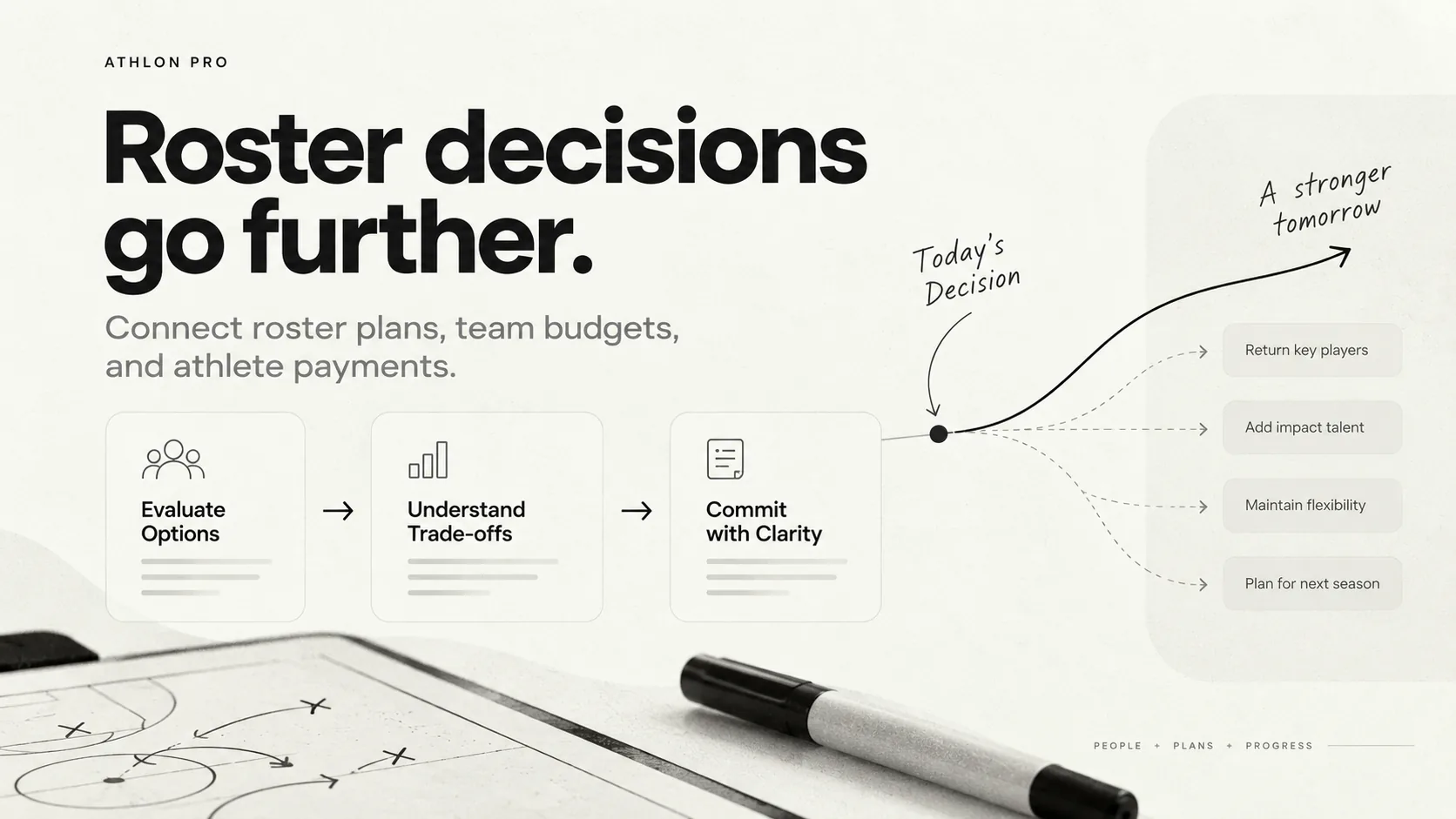
- Roster planning works best when coaches, general managers, athletic directors, and finance teams make decisions from one shared picture.
- Each group owns a different part of the process, from player evaluation and roster strategy to department priorities and financial commitments.
- Proposals, approved agreements, future obligations, and completed payments should remain clearly connected but distinct.
A coach can know exactly what the roster needs.
A general manager can know which players are available.
Finance can know exactly what the program has committed.
An athletic director can know where the department wants to allocate its resources.
And the program can still make a bad decision if those four views never come together.
That is one of the biggest operational challenges emerging in modern college athletics.
Roster construction is no longer only about identifying talent. Programs are now making decisions around roster limits, retention, revenue sharing, NIL, athlete compensation, current commitments, future obligations, and payments—often at the same time.
Following the House settlement, participating Division I schools operate under new roster-limit rules and can provide direct financial benefits to student-athletes. The NCAA describes the settlement as enabling participating schools to share up to 22% of certain average Autonomy 5 revenues with athletes, beginning with a $20.5 million cap in 2025–26.
That makes roster construction increasingly cross-functional.
The coach knows the team. The GM manages the roster. The athletic director sets broader priorities. Finance understands the commitments. The best decisions happen when all four are working from the same financial picture.
The modern roster meeting has more people in the room
Start with a common scenario.
A basketball program needs a point guard.
The coaching staff has evaluated several options and strongly prefers one player.
The GM has been communicating with the athlete's representation and knows what it may take to get a deal done.
The athletic director understands how aggressively the department wants to invest in that program.
Finance knows what has already been committed to the existing roster and what future obligations remain.
Everyone is doing their job.
The problem begins if the decision happens sequentially instead of collaboratively.
The coach says, “This is the player we need.”
The GM negotiates the number.
Finance sees the commitment later.
The athletic director discovers after the fact that the new agreement limits flexibility for another priority.
Nobody necessarily made a mistake.
They were simply making the same roster decision with different information.
A better process asks all of the important questions before the commitment is made.
Do we believe this is the right player?
What does the market require?
What have we already committed?
What does this leave available?
Does any amount carry into another season?
What other roster needs become harder to address?
And does this move fit the department's broader priorities?
That is what connected college athletics roster planning should look like.
Coaches should own the evaluation—not the spreadsheet
The head coach and coaching staff should bring the information no financial model can create on its own.
How important is this position?
What does the player add?
Can the current roster develop internally?
Is one impact player more valuable than several depth additions?
How does this athlete fit the system?
What does the team lose if a current player leaves?
These are coaching questions.
Technology should not turn them into purely financial decisions.
If the staff believes an experienced offensive lineman fundamentally changes the offense, the answer should not be:
“Option B is cheaper, therefore Option B is better.”
That misses the point.
Instead, the financial view should tell the coaching staff:
If you prioritize the experienced starter, here is what it costs.
Here is what remains.
Here are the other needs you may have to delay.
Here is what the commitment does next season.
Now decide whether the football value justifies the trade-off.
The financial information should sharpen coaching judgment—not replace it.
The GM should connect roster strategy to resource allocation
The general manager increasingly sits at the center of the modern college roster.
The role can touch recruiting, retention, player evaluation, roster construction, transfer decisions, athlete representatives, financial resources, and long-term planning.
That makes the GM the natural bridge between what the coaching staff wants and what the program can support.
The GM should be able to ask questions such as:
This is where college sports roster management becomes more than maintaining a depth chart.
The GM is helping the program build a portfolio of roster decisions.
Spend more here.
Preserve flexibility there.
Retain this player.
Wait on that position.
Take one experienced starter rather than two developmental players—or make the opposite decision because the staff values depth.
The choices remain subjective.
The financial consequences should not be.
- What are our three biggest roster needs?
- Which current athletes are our highest retention priorities?
- What range are we comfortable committing at each position?
- Which opportunities are alternatives to each other?
- Which moves can coexist?
- What do we need to reserve for later?
- Where are we willing to concentrate resources?
- What flexibility do we want to preserve for next season?
Athletic directors need the department-level view
A coach naturally focuses on the team in front of them.
An athletic director has a different responsibility.
They may be looking across football, men's and women's basketball, baseball, softball, volleyball, soccer, and every other sponsored sport while also considering department-wide financial priorities.
The question is therefore not only:
Can basketball afford this?
It may also be:
Does this decision fit how we want to allocate resources across the department?
That distinction matters more as schools operate within a new environment of direct athlete benefits, revenue sharing, roster limits, and third-party NIL activity. NCAA rules now formally connect settlement-related benefits with sport-specific roster limitations for participating Division I institutions.
A department may deliberately invest more heavily in one program.
That is a leadership decision.
But leadership should be able to see what that choice means elsewhere.
An athletics director should have visibility into:
Team allocations.
How much has been assigned to each program?
Current commitments.
How much of those resources are already spoken for?
Future commitments.
What has already been carried into later seasons?
Uncommitted capacity.
Where does the department still have flexibility?
Exceptions and assumptions.
Which projected numbers depend on decisions that have not yet been finalized?
The goal is not centralized micromanagement of every roster.
It is clarity.
Athletics finance needs to understand what the numbers represent
Finance may see numbers that look similar but mean very different things.
A proposed $400,000 offer.
A signed $400,000 commitment.
A $400,000 agreement with $200,000 still unpaid.
A $400,000 future-season projection.
Those should not all be represented as the same thing.
The roster staff understands the personnel context.
Finance understands the financial status.
Both perspectives are necessary.
That means finance should be able to answer questions such as:
Good athletics finance does not mean finance deciding which point guard to recruit.
It means the people recruiting the point guard are not making that decision with an outdated understanding of the department's financial position.
- Is this amount proposed or committed?
- Has the agreement been approved?
- What is due this season?
- What carries into the next season?
- How much has been paid?
- What remains outstanding?
- Does this payment change an obligation, or only reduce the unpaid balance?
- Which figures are confirmed and which depend on assumptions?
The status of a roster decision should change as the decision changes
One of the simplest ways to improve collaboration is to make the status of information obvious.
Consider the lifecycle of one roster move.
1. The staff explores a scenario
Nothing has been promised.
The program may be comparing several approaches.
2. A proposal is discussed
There is now a possible financial consequence, but it is not yet a signed commitment.
3. The agreement is approved and signed
The program now has a real obligation.
4. A payment schedule is recorded
The department can see when money is expected to be paid.
5. Payments are recorded
The unpaid obligation falls as payments are made.
6. The next roster decision starts
The new scenario uses the updated commitments and remaining flexibility.
That sounds simple.
But if each stage lives in a separate spreadsheet or communication channel, the distinction becomes easy to lose.
A proposed offer starts looking committed.
A commitment gets counted twice.
A payment gets mistaken for newly available roster budget.
An old version remains in someone's spreadsheet.
The problem is not necessarily inaccurate math.
It is unclear state.
Programs need one source of truth—but not one person making every decision
The phrase “single source of truth” can sound like a software cliché.
In roster management, it has a practical meaning:
Everyone should agree on the underlying facts even when they disagree about the decision.
The coach can believe the program should spend more at point guard.
The GM can prefer preserving room for a center.
Finance can point out the effect on future commitments.
The athletic director can decide the program should receive additional resources.
Those are healthy disagreements.
The unhealthy disagreement is:
“I thought we had $600,000 left.”
“My sheet says $420,000.”
“That doesn't include the agreement we signed yesterday.”
A program should spend its energy debating strategy—not debating which spreadsheet is current.
What should coaches, GMs, ADs, and finance each own?
A useful operating model does not blur everyone's responsibilities.
It makes the handoffs clearer.
Coaches and coaching staff
Own:
Need visibility into:
- player evaluation;
- positional priorities;
- fit and development;
- depth-chart implications;
- competitive needs.
- relevant budget constraints;
- trade-offs between roster approaches;
- how major commitments affect other priorities.
General managers and roster-management staff
Own:
Need visibility into:
- roster construction;
- scenario planning;
- recruiting and retention priorities;
- coordination around proposed offers;
- translating staff evaluations into roster alternatives.
- current and future commitments;
- team allocations;
- proposed amounts;
- available flexibility;
- payment and agreement status where relevant.
Athletic directors and department leadership
Own:
Need visibility into:
- department priorities;
- resource-allocation decisions;
- institutional oversight;
- balancing needs across programs.
- team-level commitments;
- future obligations;
- allocation usage;
- significant proposed changes.
Athletics finance and operations
Own:
Need visibility into:
The best operating model is not one where everybody does everything.
It is one where each group can make its decision without losing the context created by the others.
- accurate financial records;
- obligation and payment tracking;
- financial controls;
- reconciliation and reporting.
- which roster decisions have actually been approved;
- agreement terms relevant to financial tracking;
- payment schedules;
- changes that affect obligations.
AI can become the connective layer
AI becomes interesting when the underlying roster and financial information is connected.
Instead of asking someone to manually build another spreadsheet every time the staff wants to compare scenarios, the program could ask questions in the language it already uses.
A coach might ask:
If we prioritize a starting center, what does that leave us for another guard?
A GM might ask:
Compare retaining these two players with using those resources on three additions.
An athletic director might ask:
Which proposed commitments would create the most pressure next season?
Finance might ask:
Which approved obligations still have outstanding payments?
The value is not simply getting an answer.
It is getting an explanation of the trade-off.
Why does one option leave more flexibility?
Which existing commitments are driving the result?
What assumptions matter?
What changes if one proposal is removed?
The AI should help make the information easier to understand.
The people still make the decisions.
Better internal collaboration also creates a better athlete experience
There is another side to this.
An athlete should not need to know how many internal spreadsheets a department uses.
Neither should a parent or representative.
If the athlete has an agreement with the program, basic questions should have clear answers.
What was agreed to?
When are payments expected?
What has been paid?
What remains?
Who should address a discrepancy?
If coaches, roster staff, and finance are working from disconnected records, those questions become harder to answer consistently.
Better internal operations can therefore improve the experience on the other side of the agreement too.
And once an athlete receives compensation, another financial challenge begins: understanding taxes, budgeting, saving, cash flow, NIL income, and longer-term money management.
Those are different responsibilities from the department's roster-budget process, but they are part of the broader financial reality surrounding today's college athlete.
The institutional side needs clarity around what it promises and pays.
The athlete side needs financial literacy around what is received and how to manage it.
Both benefit from better financial infrastructure.
1. What problem are we trying to solve?
Is the priority a starter, retention, depth, development, or future roster flexibility?
2. What have we already committed?
Not what has been paid.
What has actually been promised?
3. What does this option change?
This season, next season, and across the rest of the roster plan.
4. What are we giving up?
Which position, retention priority, or future opportunity becomes harder if we make this move?
5. What happens after we agree?
Who records the commitment, tracks the payment schedule, updates the obligation, and makes sure the next roster decision starts with the new information?
If the coach, GM, AD, and finance staff can answer those five questions from the same underlying information, the program is in a much better position to make a deliberate decision.
What does effective college athletics roster collaboration look like?
Effective college athletics roster planning gives coaches, GMs, athletic directors, and finance teams a shared understanding of roster priorities and their financial consequences while preserving each group's responsibility.
The coaching staff evaluates the team.
The GM builds roster alternatives.
Athletics leadership allocates resources.
Finance tracks commitments and obligations.
And the information connects those decisions rather than forcing people to reconstruct them afterward.
That is the operating model college athletics increasingly needs.
Not more meetings.
Not more spreadsheets.
Not software making personnel decisions for the staff.
Better alignment between the people already responsible for building and supporting the roster.
The strongest roster plan is not simply the one with the best players on paper.
It is the one the coaching staff believes in, the GM can execute, the department can support, and the program can follow through on.
Frequently asked questions
Roster planning typically benefits from coordination between coaches, general managers or roster-management staff, athletic directors or department leadership, and athletics finance or operations. Each group brings different information: player evaluation, roster strategy, department priorities, and financial commitments.
The exact role varies by institution and sport, but college athletics general managers can work across roster construction, recruiting, retention, player personnel, athlete-representative conversations, and resource planning. The role increasingly connects coaching priorities with the operational and financial side of building a roster.
Finance does not need to evaluate players. Its role is to help ensure that proposed and approved roster decisions are reflected accurately in commitments, future obligations, payment schedules, and available resources.
AI can help compare roster scenarios, calculate financial consequences, identify trade-offs, and explain how different decisions affect current and future flexibility. Player evaluation, priorities, and final decisions should remain with the staff.
Not necessarily. Athletes and their representatives may need clear information about their own agreements and payments, but that does not mean they should have access to another athlete’s information or the department’s complete internal roster strategy.
See what Athlon Pro can do
Explore roster alternatives and understand every commitment before you make it.
Request a Demo