Summary
- College athlete income is often irregular and comes from several sources, so its structure matters as much as the amount.
- Build recurring expenses around a baseline cost of living, not your best earning month.
- If taxes were not withheld, part of every deposit may belong to a future tax bill.
For many college athletes, the first meaningful paycheck does not arrive the way it does for most people their age. There may be no predictable salary that lands every other Friday. Income can come from an NIL partnership one month, an appearance or social campaign the next, institutional athlete compensation, and several smaller opportunities throughout the year. Some payments may have taxes withheld. Others may not. Some opportunities may last several seasons; others can disappear almost as quickly as they arrived.
That creates a financial life that looks less like a typical college student and more like someone running a small, highly variable business while also going to class, practicing, traveling, and competing. An athlete who earns $50,000 irregularly may need a very different financial system from someone earning the same $50,000 through a predictable salary. One can build recurring expenses around a known paycheck. The other has to make decisions without knowing exactly what next month, or next season, will look like.
That is why financial literacy for college athletes has become more than knowing how to make a budget. The real skill is learning how to turn volatile income into financial stability.
More athlete income creates more financial decisions
College athletes now operate in a financial environment that would have been almost unrecognizable a few years ago. NIL created opportunities to earn through endorsements, sponsorships, content creation, appearances, and autograph sessions. The House settlement added another layer by allowing participating Division I institutions to provide direct financial benefits to athletes. The IRS now identifies both NIL income and revenue-sharing payments from a university among the forms of income student-athletes may receive.
That does not mean every athlete is suddenly wealthy. It means more athletes encounter meaningful financial decisions earlier in life, with less predictability than the typical student. A quarterback with a large endorsement may need to think about taxes, cash reserves, and future volatility. A volleyball player earning several smaller NIL payments faces many of the same questions at a different scale. A baseball player receiving institutional compensation while also earning from camps may have several income sources to track.
Once money starts arriving from multiple places, the athlete needs to understand what came in, what portion is truly available to spend, what may be owed later, and what should be preserved for the future.
A good month is not the same thing as a new lifestyle
One of the hardest adjustments to variable income is separating what you earned this month from what you can sustainably afford every month. Imagine an athlete who earns $8,000 from a summer sponsorship, $2,500 in August, nothing in September, and $6,000 in October. The average looks healthy over several months. Living through those months feels very different.
If the athlete responds to the $8,000 month by permanently increasing rent, car payments, and subscriptions, those bills continue even when the next month produces very little. That is the central problem with lifestyle inflation for someone whose earnings fluctuate.
“The goal of budgeting is not to make someone feel poor while they are earning well.”
A more resilient athlete budget starts with a baseline cost of living rather than the best earning month. Housing, food, transportation, insurance, and recurring bills establish what normal life requires. Variable income can then be allocated around that foundation instead of immediately becoming a new recurring expense.
For athletes, flexibility has real value. An athlete may transfer. A season may end early. An NIL deal may not renew. Injuries, role changes, and market conditions can affect earning power quickly. A good budget acknowledges that uncertainty rather than pretending it does not exist.
The number deposited may not be the number you can spend
Taxes are where this becomes especially important. Depending on the facts, some athlete income may be treated as employee compensation while other income may be independent-contractor or self-employment income. The IRS notes that NIL income generally must be reported even when the athlete does not receive a Form 1099 or W-2, and that non-cash compensation can also be taxable. So a simple habit matters: do not automatically treat every dollar received as spendable cash.
For income without sufficient withholding, taxpayers may also need to make estimated tax payments during the year, part of the tax system's pay-as-you-go structure. The exact amount to reserve depends on income, deductions, state, and tax classification, which is where a qualified tax professional becomes important.
If $10,000 arrives and no taxes have been withheld, the responsible starting point is not "I just made $10,000 I can spend." It is "How much of this is actually mine after taxes and other obligations?" That small shift can prevent a very large problem later.
Organize the money before optimizing it
Athlete finance conversations often jump straight to investing. That is understandable, but investing is usually not the first problem. Before deciding where money should grow, an athlete should understand where it comes from and what responsibilities already attach to it. That means being able to answer questions like these:
- How much did I earn this year, and which payments were NIL income?
- Which payments had taxes withheld, and how much have I reserved?
- What expenses did I incur while earning that income?
- What are my normal monthly expenses and existing commitments?
- How much cash do I have if income slows down?
The IRS advises student-athletes earning NIL income to track income and relevant business expenses and keep supporting records such as receipts, travel logs, and mileage. That organization is not glamorous, but budgeting, saving, investing, and tax planning all become easier when the athlete actually knows what happened to the money.
Saving is not just about retirement when income is unpredictable
When people hear "save your money," they often imagine something decades away. For an athlete, savings serve a much more immediate purpose: they create optionality. Savings can cover an unexpected tax payment without a credit card, carry normal expenses when an endorsement ends, make a move after transferring easier, and reduce pressure to accept an opportunity simply because cash is tight.
Most importantly, savings buy time. An athlete earning meaningful money at 20 may assume current income is the start of a permanent upward curve. Sometimes it is. For many, it will not be. Even future professionals enter careers that are volatile and physically uncertain, and athletes who do not play professionally may move from several years of unusual earning straight into a different income structure. Saving during strong periods is less about fear and more about preserving future choices.
Build the budget around buckets, not predictions
A useful way to handle irregular income is to give money a purpose before lifestyle spending absorbs it. Percentages vary by person, and no generic formula is personalized advice, but the structure helps:
- Taxes: money that may ultimately be owed to federal, state, or local authorities.
- Core living expenses: the recurring amount required to maintain normal life.
- Emergency and short-term savings: cash for slow periods or unexpected costs.
- Longer-term goals: investing, education, a future home, or life after sport.
- Flexible spending: money to enjoy without jeopardizing the other priorities.
The important part is separation. Without it, the checking-account balance becomes the financial plan: if it is high, spending feels affordable; if it falls, the athlete reacts. With a system, the athlete understands that money sitting in the account may already have a job.
NIL income can turn an athlete into a business operator
Some athletes are managing business activity before they ever think of themselves as business owners. An endorsement requires deliverables. A campaign involves content production. An appearance creates travel expenses. Income arrives from several companies, contracts have to be understood, tax forms arrive, and deadlines matter. For athletes treated as independent contractors, federal obligations may include self-employment tax in addition to income tax.
That is why NIL financial literacy is not just knowing what an endorsement is. It is understanding the financial system surrounding the opportunity. An athlete may have a great agent, a helpful parent, and a CPA, and still benefit from understanding their own cash flow and why records matter. Professional help is valuable; financial understanding is what lets the athlete use that help intelligently.
The people around the athlete should make the picture easier to understand
Athletes rarely make every financial decision alone. Parents, agents, managers, accountants, advisors, and schools can all play a role, and that support is especially valuable when navigating contracts and taxes for the first time. But good support should not require the athlete to become passive.
The athlete should still know how much came in, who paid it, what is expected next, what may be owed, how much is being saved, what recurring expenses exist, who has access to their accounts, and what decision they are authorizing. The goal is not for every athlete to become a financial expert. It is to know enough to recognize the questions that matter.
The department's system and the athlete's financial life are connected, but different
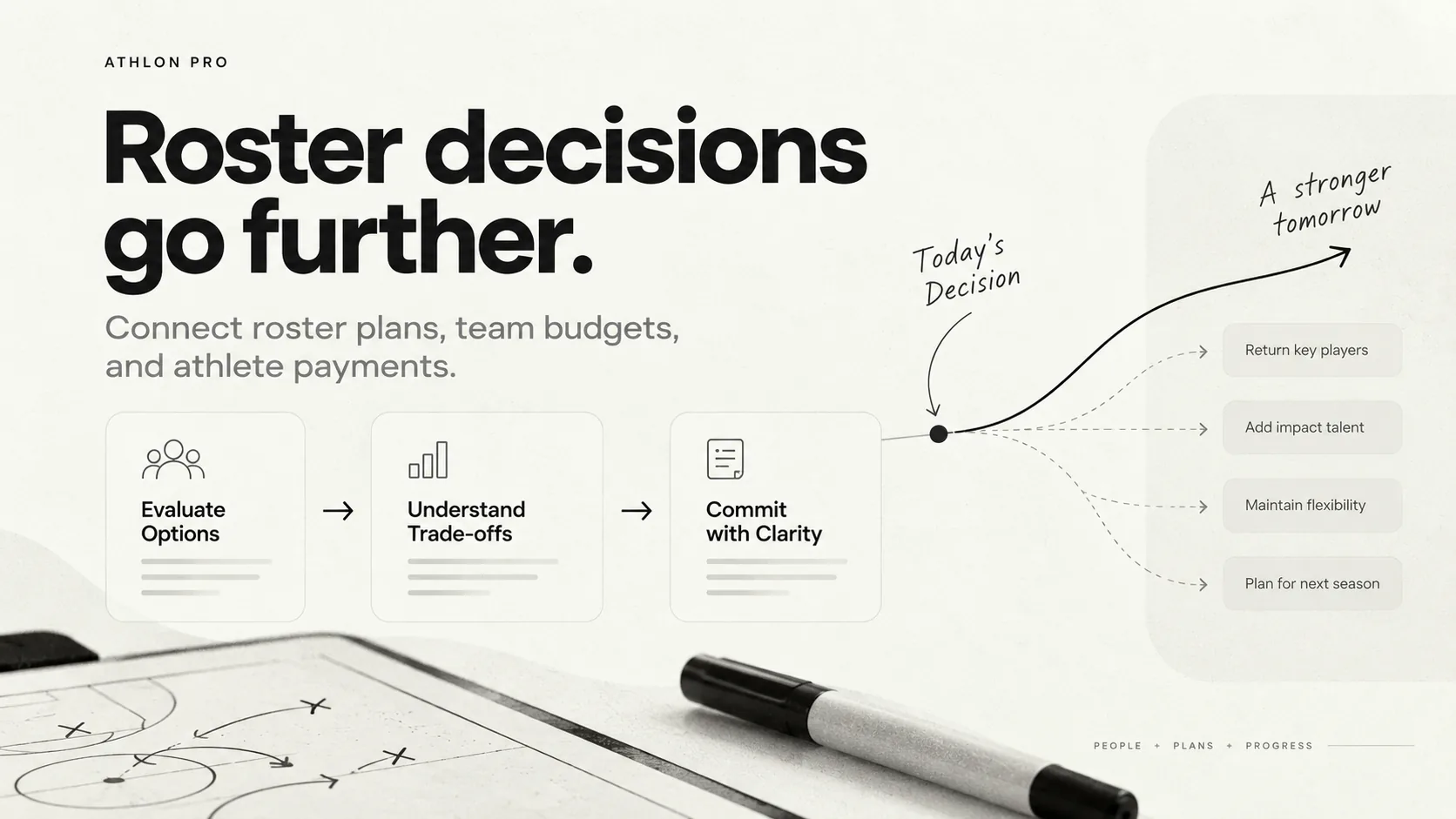
A university may need to track what it has agreed to pay an athlete, when payments are scheduled, what has been paid, and what remains outstanding. The athlete has a different problem: once the money arrives, how much to reserve for taxes, what to spend, what to save, and how it fits with other income.
Those systems concern the same payment, but they should not become the same account. A department's roster-management access should not expose an athlete's personal bank accounts, private budget, tax situation, savings, or unrelated deals. At the same time, better institutional records help create clarity for the athlete, because both sides benefit from knowing what was agreed and what remains outstanding.
“Programs need better infrastructure for managing what they commit. Athletes need better infrastructure for managing what they receive.”
The best financial habit may be resisting the urge to look rich
For an athlete earning money publicly, there is another layer of pressure. Friends see sponsorship announcements, followers see the content, and teammates have their own opportunities. A headline number can suggest more disposable money than the athlete actually has, which makes lifestyle inflation social as well as financial.
Public perception sees gross income. It does not see taxes, agent fees where applicable, business expenses, savings goals, irregular future income, or the fact that a one-time payment is not an annual salary. An athlete should be able to enjoy earning money without needing to prove to everybody else that it was earned.
The goal is not to spend less. It is to create control.
Financial literacy is sometimes presented as a list of restrictions: do not buy this, save everything. That framing misses the point. The purpose is control. An athlete who understands their money can make a larger purchase and know it fits, help a family member and understand the effect, invest because short-term obligations are covered, and negotiate an opportunity while understanding the after-tax economics.
Good money management gives athletes more freedom to make intentional choices. Poor money management turns every decision into a reaction to whatever happens to be in the account.
A simple financial system for a college athlete
An athlete does not need a complicated wealth-management structure to start building better habits. A useful starting system is straightforward:
- Track every source of income, including NIL and institutional compensation.
- Know whether taxes are being withheld rather than assuming they are.
- Separate money that may be owed for taxes from ordinary spending money.
- Build a realistic baseline budget around normal expenses, not peak income.
- Create savings before increasing permanent lifestyle costs.
- Keep records of income and relevant expenses.
- Use qualified tax or financial professionals when the situation requires it.
- Understand what other people are doing with or on behalf of your money.
The system can grow more sophisticated as the athlete's finances do. The first objective is simply to make the money understandable.
A short earning window can still create a long financial advantage
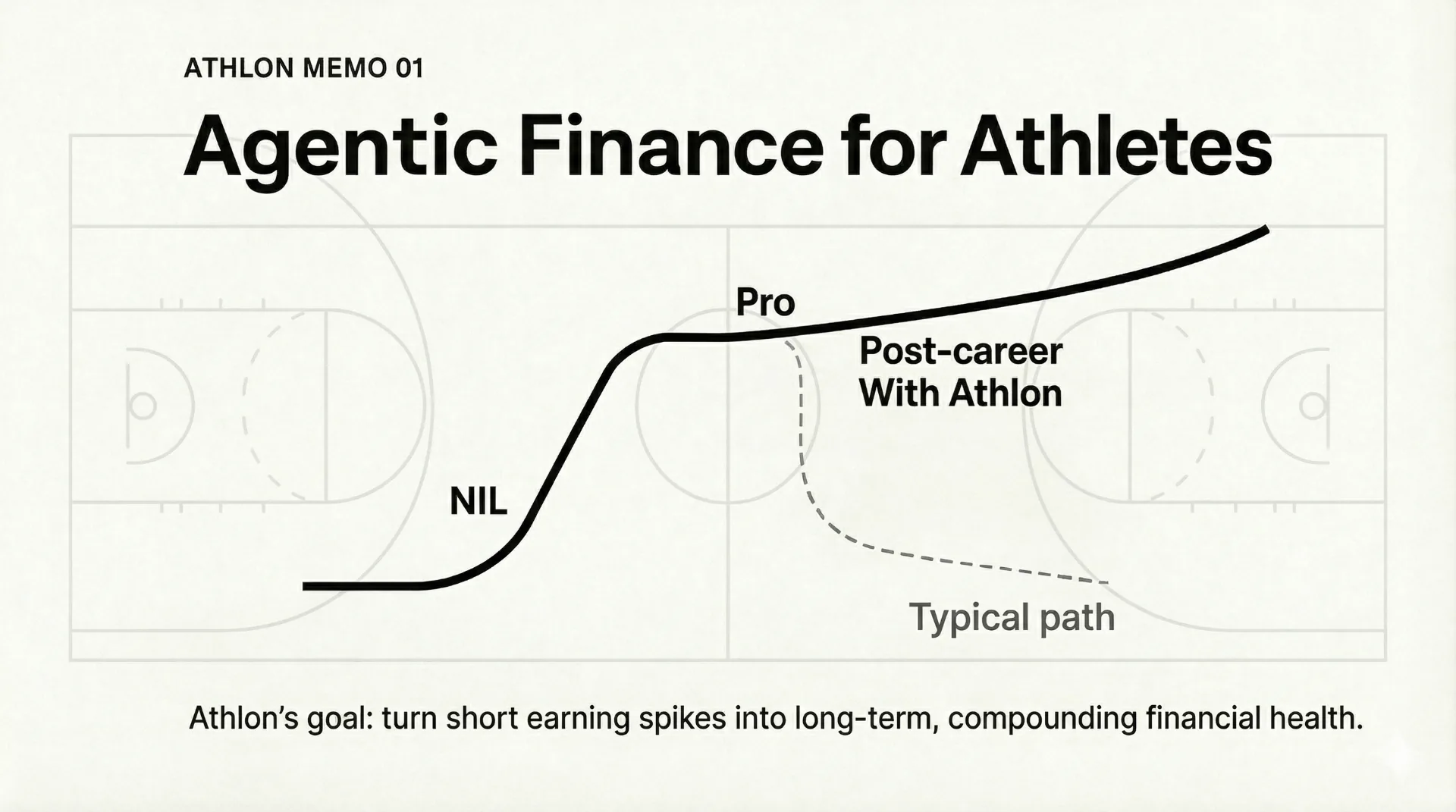
The most interesting opportunity in athlete finance is not just that some college athletes can earn money earlier. It is what that money can become. A few strong earning years can disappear into a lifestyle that requires the next deal to arrive. Or they can create savings, fund education, support a business, provide investment capital, or let an athlete enter the next stage of life with more options.
The difference usually begins with unexciting fundamentals: tracking, budgeting, setting aside taxes, saving, and understanding cash flow. Athletes spend years learning that performance is built through repeated fundamentals. Money is not very different. The goal is not to predict exactly what an athlete will earn next year. It is to build a system strong enough that the prediction does not need to be perfect.
“The athlete paycheck is different. The financial habits around it should be different too.”
Frequently asked questions
It helps athletes manage income that may be irregular, come from multiple sources, and create tax obligations. Athletes who understand budgeting, saving, taxes, and cash flow are better positioned to turn short-term earning opportunities into longer-term financial flexibility.
Generally, yes. The IRS states that NIL income is taxable and must be reported even when an athlete does not receive a Form 1099 or W-2. The specific treatment can depend on whether the athlete is treated as an employee or independent contractor and the type of income received.
Athletes receiving income without sufficient withholding may need to reserve money for federal, state, or local taxes and may be required to make estimated tax payments. The right amount depends on individual circumstances, so a qualified tax professional can help determine it.
Build recurring expenses around a conservative baseline rather than the highest earning month, then separate incoming money among taxes, living expenses, savings, longer-term goals, and flexible spending.
Records of income and relevant expenses, including receipts and travel or mileage records where applicable. The IRS recommends tracking expenses associated with generating NIL income because some may affect tax reporting.
Professional help becomes valuable with multiple income sources, self-employment income, contracts, significant tax obligations, or complex decisions. Athletes should still understand the basics of their own finances so they can evaluate advice and stay involved.
Built for the financial life of an athlete.
Athlon is building tools to help athletes understand income, budgeting, taxes, saving, and long-term financial decisions.
Learn about Athlon